Page 6
02/07/2026

Dear diary, I am tired.
Unfortunately, the law isn’t getting tired and updates are still dropping in hot! Here:
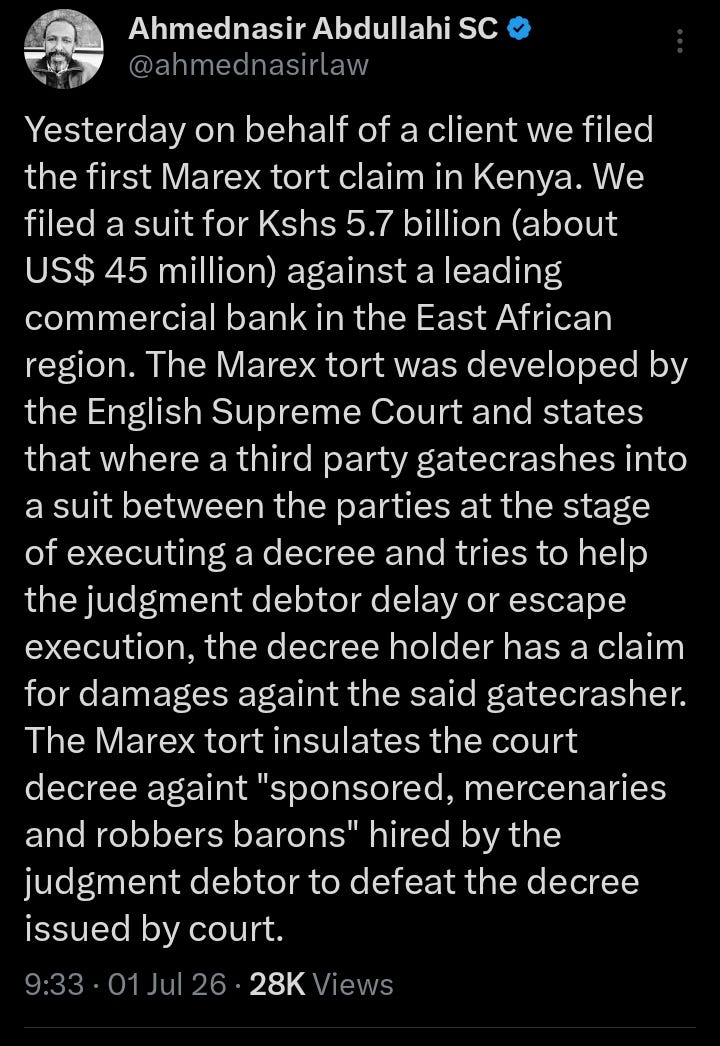
Marex Tort - As Grand Mullah has explained on the tweet above, a marex tort is an English common law economic tort that allows a judgment creditor to sue a third party for damages if that third party intentionally assists a debtor in hiding assets or evading a court judgment. It was developed in the UK Supreme Court case Marex Financial Ltd v Sevilleja (2020).
Brief background: Marex Financial Ltd had obtained a judgment worth over US$5 million against two companies owned and controlled by Mr. Sevilleja. Before the judgment could be enforced, substantial sums were transferred out of the companies, leaving them effectively assetless and unable to satisfy the judgment debt. Marex then sued Mr. Sevilleja personally.
What the High Court said: The Court held that there was a serious and arguable basis for imposing liability where a person knowingly induces, procures or participates in conduct intended to defeat or frustrate a judgment creditor’s rights. It reasoned that if the common law protects contractual rights from intentional interference, then rights confirmed by a court judgment deserve equal, if not greater, protection.
What the Supreme Court said: When the matter reached the UK Supreme Court, it primarily dealt with the doctrine of reflective loss and allowed Marex’s claim to proceed. However, it did not conclusively determine the question of whether English law recognises a standalone tort of interference with judgment rights. As a result, the Marex Tort remains an evolving common law principle (or is it concept?) rather than a settled cause of action.
Also, just so we’re ready incase they decide to ask more about it in the oral exams, here are the elements that must be proved for a marex tort:
i. An Enforceable Obligation - The Plaintiff should possess a valid, binding judgment, decree or court order;
ii. Knowledge -Plaintiff must show that the third party (defendant) knew of the existing judgment/decree/court order. Here, the defendant need not know every detail of the judgment, knowledge of its existence is generally sufficient;
iii. Deliberate Interference - The defendant actively assisted, induced, or facilitated conduct designed to undermine the creditor's enforcement rights;
iv. Intentional Conduct - The defendant's actions were intended to help the debtor evade the judgment. Note: Any active step taken by the defendant that knowingly facilitates the breach may amount to procurement or inducement.
v. Resulting Loss - The creditor suffered financial loss as a direct result of the defendant's interference.
Can you be convicted of intermeddling for selling land you expect to inherit? The High Court at Nyeri answered this on Monday with a NO in the case of Magondu v Republic [2026]. In that case, the appellant had been convicted of intermeddling with a deceased person’s estate after entering into a sale agreement over land she expected to inherit from her late father.
On appeal, however, the High Court noted that the standard of proof for criminal charges is very high and found that the prosecution had failed to prove some of the most basic facts. It had not produced evidence that the land was registered in the deceased’s name, that the deceased was in fact the appellant’s father, or even that he was dead.
The Court also noted that the appellant had not actually transferred the land. She had merely entered into a sale agreement based on what she anticipated would eventually be her share of the estate. In fact, the agreement expressly provided that the purchaser would only take possession after the succession process had been completed.
The conviction was therefore quashed and the sentence set aside.
Takeaway: Not every agreement involving estate property amounts to intermeddling. And in criminal proceedings, the prosecution must prove every essential element of the offence. It cannot rely on assumptions, however obvious they may seem.
On the Cybercrimes Act - Petition E671 of 2025, Law Society of Kenya and Others v Attorney General and Others. The High Court held that section 6(1) of the amended Computer Misuse and Cybercrimes Act was unconstitutional on the grounds that it was impermissibly vague and failed to satisfy the constitutional requirements for the limitation of rights under Article 24 of the Constitution. The Court further declared section 27(1)(b) unconstitutional, finding that its lack of clarity rendered it inconsistent with the constitutional principle of legality and therefore incapable of meeting the standards of constitutional validity.
FYI:
Section 6(1)(ja) — empowers the National Computer and Cybercrimes Coordination Committee (NC4/NCCCC) to unilaterally block websites/apps promoting "unlawful activities," "religious extremism," or "cultism," without an application and approval from Court.
Section 27(1)(b) — criminalizes communication "likely to cause" another person to commit suicide, with penalties up to Kshs 20 million and/or 10 years' imprisonment.
Did I miss a legal update, judgment, gazette notice, or development worth knowing about? Drop it in the comments. My future self (and possibly other confused law students) will thank you :)
Legally yours,
Rose.