Page 4
30/06/2026

Dear Diary,
The last few days have been a bit hectic. Anyways, here is today’s page:
The Court of Appeal has stayed the High Court decision on the Safaricom case - The conservatory orders that had been given by the High Court forbidding the sale of shares are now not in effect. In simple terms, Safaricom can now proceed with the planned sale.
Rule 5(2)(b) CoA Rules - gives the court discretionary power to grant interim relief (such as a stay of execution or injunction) while an appeal or intended appeal is pending. There has been an ongoing online debate that the Court of Appeal has been abusing this rule, esp Kiage J in matters involving the govt. One such instance is the safaricom case in (1) above.
FYI, there’s a two-limb test that must be satisfied under this rule:
a. Whether there is an Arguable Appeal: The intended appeal must be arguable (not frivolous) and raise legitimate, bona fide grounds.
b. The Nugatory Test: The applicant must prove that if the interim relief is denied, the eventual appeal will be rendered nugatory (i.e., worthless, futile, or resulting in irreversible damage.
PS. Both of these conditions must be met concurrently; failure to prove even one is fatal to the application.
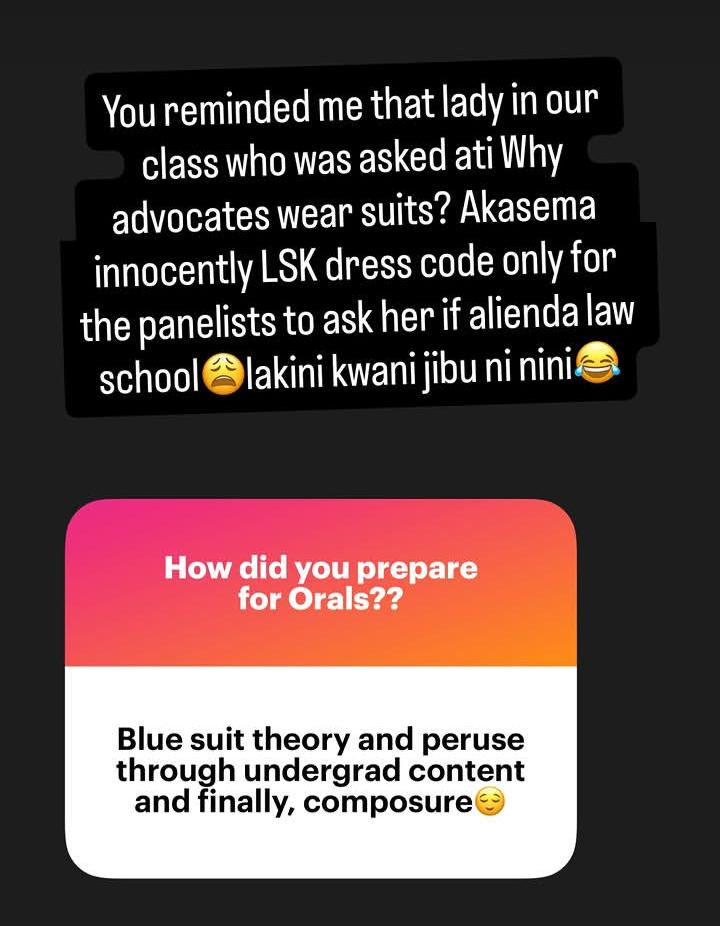
Why do Advocates dress the way we do? - apparently just relying on the LSK dress code isn’t an enough answer. You have to get into:
i. The history and evolution of the legal profession
ii. Dimensions of Trial Advocacy (Humans are more visual)
iii. The science of colors
iv. Legal Practice as an honorable profession
i. The history and evolution of the legal profession
Kenya inherited much of its legal tradition from England through colonialism. Ik you already know that. Anyways, in case you didn’t know, now you do. The robes, bands, and formal attire are descendants of English court dress, which itself evolved over centuries. However, the idea that legal advocates should look different predates England.
In Ancient Greek courts, advocates generally did not wear robes. What mattered wasn't the outfit itself but whether you looked respectable enough for people to trust you. Aristotle would probably say your appearance contributes to your ethos (credibility), alongside your logic and emotional appeal.
Fast forward to 17th-century England, judges began wearing standardized robes, barristers followed suit and wigs eventually became symbols of office. They were fashionable at the time, but even after society moved on, the legal profession kept them. Why? Because they had come to represent continuity, dignity, impartiality and the authority of the courts.
Kenya simply inherited much of that tradition.
ii. Dimensions of Trial Advocacy (Humans are more visual)
This reminded me of something we learnt in ATP 104: the trial begins long before the first word is spoken.
There’s a psychological concept called the primacy effect, which suggests that people form impressions within seconds. Advocates aren’t exempt from that reality. Someone who appears organised, composed and professional is often perceived as more competent before they even begin their submissions.
At the end of the day, judges are human too. Formal attire helps minimise distractions and shifts the focus from the advocate’s appearance to the arguments they’re making.
iii. The science of colors
Apparently, colour psychology associates black, navy, grey, and other muted colours with authority, seriousness, restraint, and professionalism. Bright colours naturally attract attention, which is great for a fashion show... but perhaps not when you’re trying to persuade a court.
The idea is that the advocate shouldn’t become the centre of attention. The case should.
(Sorry, Elle Woods. 🌸)
iv. Legal Practice as an honorable profession
In ATP 105 (professional ethics) we learnt that the legal profession is not merely a business but a learned profession. That means advocates owe duties not only to their clients but also to the court and to the administration of justice. Sometimes those duties even require an advocate to act against a client’s immediate wishes, for example, by refusing to mislead the court.
Viewed that way, the robe becomes more than just clothing. It’s more of a reminder that an advocate appears before the court not only as a representative of a client, but also as an officer of the court entrusted with upholding the integrity of the justice system.
All in all, I kinda wish I lived in the Legally Blonde universe where I could wear pink to court :)
But until then, dull outfits it is.
Did I miss a legal update, judgment, gazette notice, or development worth knowing about? Drop it in the comments. My future self (and possibly other confused law students) will thank you :)
Legally yours,
Rose.